As the days get shorter, being seen can save your life
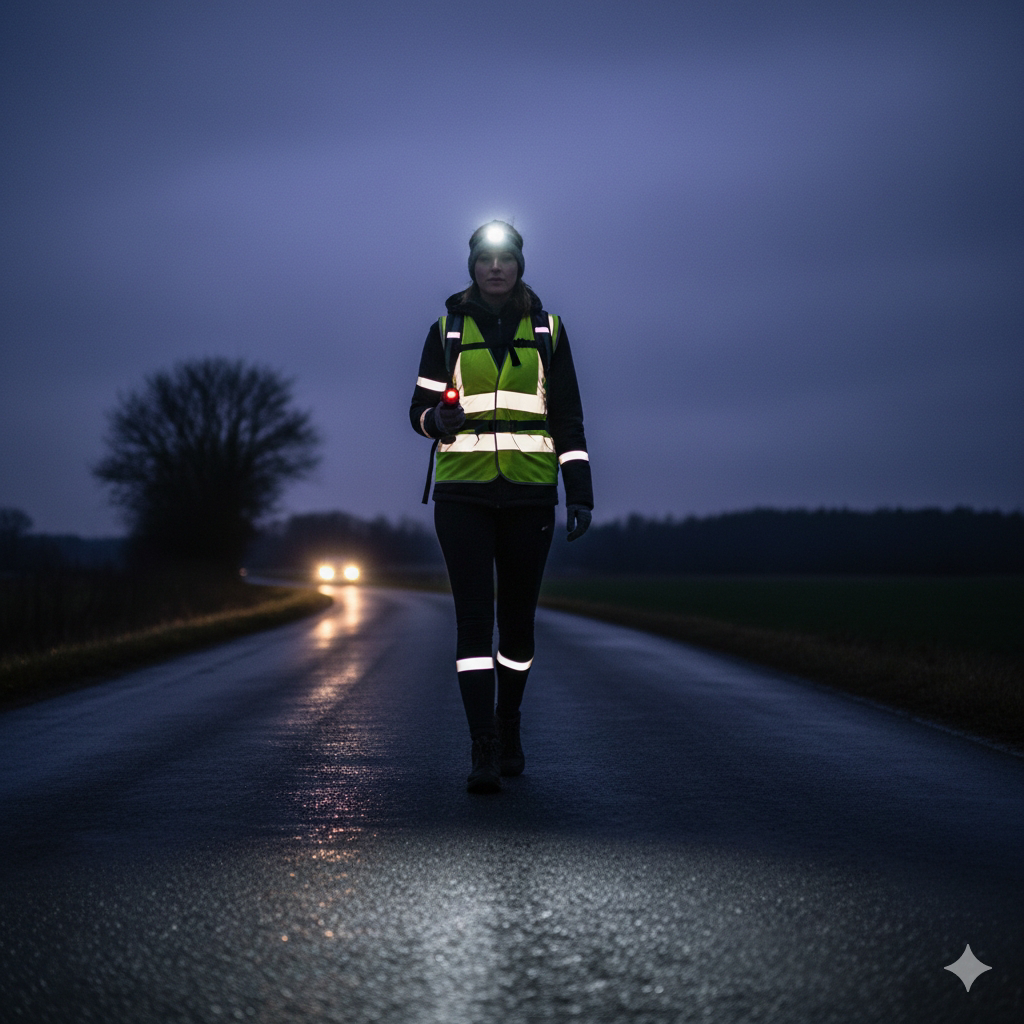
As autumn arrives and winter gets closer, we spend more and more of the day in the dark. Early dusk and late sunrise don't just affect your mood, they are a serious danger on the roads too, especially if you're on foot. On stretches with poor street lighting or none at all, a pedestrian becomes almost invisible to drivers, and the risk of an accident goes up dramatically.
Year after year the figures confirm the same sad fact: in the autumn and winter months, as natural light fades, more pedestrians get hit by cars. With dipped headlights, a driver only spots a pedestrian in dark clothing from about 50 metres away. Even with an emergency stop, that distance isn't always enough to avoid a tragedy, especially on a wet, slippery road.
The bare minimum: something reflective
In some countries the traffic code says it outright: at night and in poor visibility, a pedestrian walking outside built-up areas on the road, the verge or the hard shoulder must wear a reflective vest, however well the vehicles are lit. That rule wasn't made up by accident. A reflective vest, or even just a strip of reflective tape on your clothes or bag, makes you visible from several times further away. A driver on dipped headlights can spot you from as far as 150-200 metres, and on full beam that can go up to 350-400 metres. That extra distance, and the reaction time it buys the driver, can save lives.
Still, a lot of people avoid these simple, effective things. The reason is often psychological: we tend to overestimate how visible we are. Because we can see the oncoming car's headlights, we wrongly assume the driver can see us. That dangerous belief ignores the driver's point of view, the dark surroundings, the limited angle of the headlights and anything that might be distracting them.
The best solution: your own light
Wearing reflective gear is essential, but a passive visibility aid only works as well as the light that hits it, usually the headlights of an approaching vehicle. On a winding road with poor sight lines, just over a crest, or if the vehicle's headlights are dirty, a reflector does a lot less.
Real safety, and the proactive solution, is your own active light. A handheld torch, a headlamp or an armband light doesn't just make you visible from far away. It gives you something a reflector never can: you can see too.
Walking on a poorly lit road, it's easy to trip on a pothole or a branch, or miss the edge of the verge. Your own light makes walking safer, because you spot obstacles in time and avoid injuries from a fall. On top of that, an active light, steady or flashing, moves with you, and that catches a driver's attention far better than a static reflective surface.
Think of cyclists: traffic rules generally require them to use lights after dark. Pedestrians may be slower, but they are among the most vulnerable people on the road just the same.
As the nights get longer, our responsibility grows too. Don't leave your safety to luck or to the alertness of oncoming drivers! Do everything you can to be seen: a reflective vest or tape is the basic minimum, but if you regularly walk on badly lit roads, the best investment is a light of your own. See and be seen: these two simple rules can save lives on long, dark evenings.
Lighting: where to go next
- Torches under the magnifying glass: all my tests in one table - if you're choosing a torch, start here
- What is colour temperature, and why does it matter when choosing a torch? - most people skip this, yet it decides how usable a light is
- Fenix HM75R Topaz headlamp test
- Sofirn HS21 headlamp test - ring mode selector, gesture control, red light
Lamps and lightHealth and first aid
PrepperPapa app
Preparedness in your pocket
Stock with expiry tracking, emergency card, compass, map and knowledge base in one app. The essentials work without internet.
See what it can do