This light can light your way, but its real job is getting you found
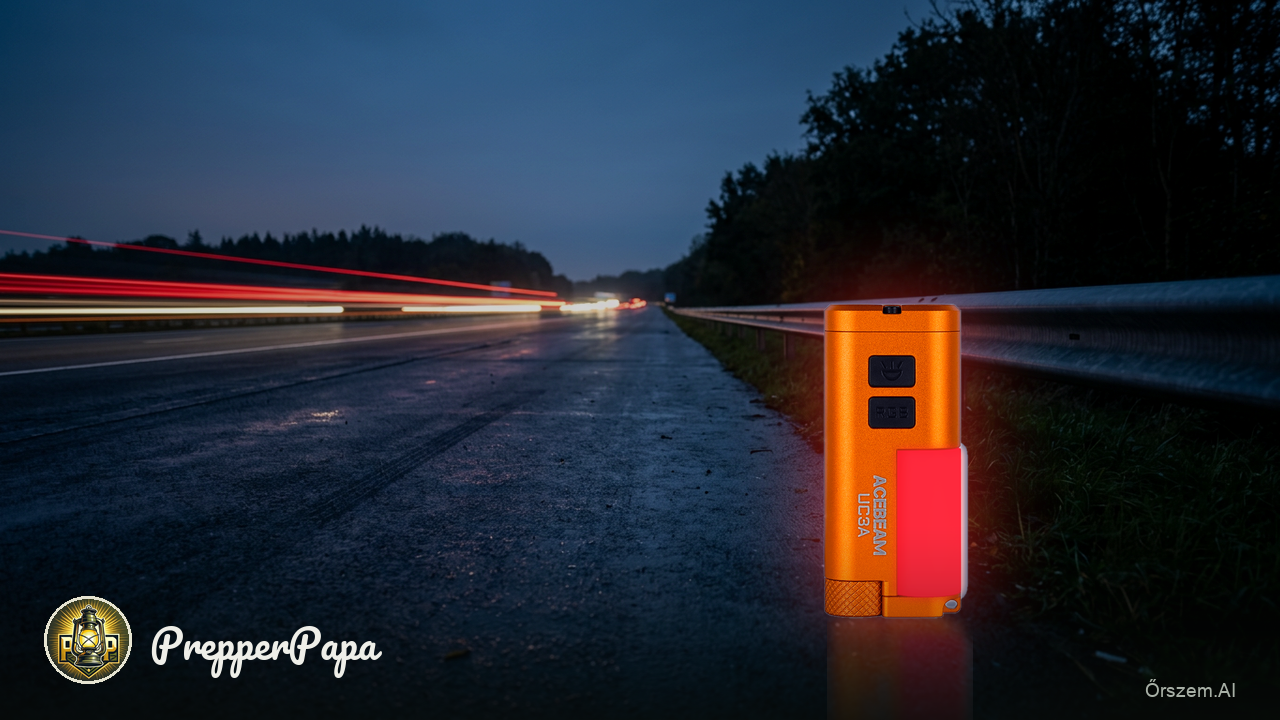
Last night I went out into the dark yard with a light whose box promises 900 lumens. Fifteen seconds later it wasn't 900 lumens any more. That didn't turn out to be the lesson of the evening.
The lesson was that the most interesting thing about this light isn't at the front, it's on the side. A palm-sized coloured panel that can light things up, but is worth the most when it isn't lighting, it's signalling. When its job isn't to help you see, but to get you seen.
53 hours. That's how long you stay visible
On the side of the Acebeam UC3A sits a wide light panel that can shine white, red, green and blue, steady or flashing. According to the manufacturer, red flashing on the lowest setting runs for 53 hours. Green and blue the same.
That's two and a half days. From a tiny rechargeable cell, or from one AA battery.
Think about what that means in practice. You break down on a country road, in the evening, just after a bend. You get stuck on a forest track with no signal. You get lost on a hike and people will be out looking for you. In all three, the question isn't what you can see. It's when someone notices you.
A powerful light isn't worth much then. Point it up and you blind whoever is looking for you. Point it at yourself and you achieve nothing. A flashing red dot, on the other hand, does exactly what's needed: it stays where you are and asks for nothing in return.
Signalling is not the same as lighting
It's not that signalling rules out lighting. The same light does both, and the side panel on white lights up a tent or a car boot comfortably. The problem is that most people look at only one thing when buying a light: how far it shines. That's logical for everyday use, but in an emergency it leads you astray.
Lighting eats energy. Signalling hardly uses any. The same charge that's gone in half an hour on the main beam lasts several days on the signal light. That's why, in an emergency kit, a signal function is worth more than another two hundred lumens.
And it has a practical use that isn't an emergency. At night on a bike, walking the dog along the road, or on a child's backpack, the same flashing panel simply makes you visible. A steady red light also doesn't ruin your night vision, which outdoors is worth more than brightness.
Where to put it so you really get seen
A signal light is only as good as where you put it. Three places where, in my experience, it works.
By the car's rear window, visible from outside. If you're standing at the roadside in the evening, it's the driver coming from behind who won't see you in time. Thanks to the magnetic cap you can also stick it on the bodywork, so you don't have to hold it or prop it up.
On top of the backpack or on the shoulder strap. On a hike, if you're still out after dark, you can't be seen from behind. A flashing dot on the backpack does more than a bright light in your hand, because that one shines forwards, not backwards.
By the door, where you can reach it. In a power cut most people switch on their phone's torch, and two hours later they don't have a phone either. A light kept in a fixed place is worth far more, because you don't have to look for it.
And if you have several colours, use them: with several vehicles or several people, different colours help you tell who is standing where.
What this light is, by the way
Two white LEDs at the front, the wide coloured panel on the side, and a separate switch for each. Aluminium body, dust- and waterproof, and a drop from one and a half metres won't hurt it. It's the size of a thick bank card and weighs 63 grams, so you forget it's in your pocket. It costs $34.90 and comes with a ten-year warranty.
Power comes from a USB-C rechargeable cell that's included. If that runs flat and you have nothing to charge it with, an ordinary AA battery will run it. For me that's not the main argument, just a good feature: it means the light doesn't die because there's been no power for three days.
900 lumens for fifteen seconds
What's worth knowing about the main beam is that it holds its peak for fifteen seconds, then steps down twice, and runs out at around half an hour. The manufacturer states this openly, you don't have to dig for it.
It's not a fault, it's physics: a 63-gram light has nowhere to shed the heat, so it either steps down or it fails. The practical consequence matters, though. If you buy it for the peak figure, you'll be disappointed. If you plan with the middle setting, which lasts almost two hours, you get exactly what you expected.
Honestly, in everyday life you don't need 900 lumens anyway. In a dark cellar, under the bonnet or in front of a tent, the strongest setting dazzles more than it helps.
What I didn't like
One thing properly bothered me last night, and it's exactly the light's strength. The side panel sits on one side of the light, and the switch is on top. If you're right-handed and hold it so the button falls comfortably under your thumb, the coloured panel faces inwards, so it lights up your own palm. You can turn it round in your hand, but then the switch ends up in the wrong place. Held in one hand, either the light faces the wrong way or the button does.
That's not a fault, it's a design decision with a price. But it tells you something: this light isn't meant to be clutched in your fist.
Clipped to a cap
Because as soon as you put it down or clip it somewhere, the problem disappears, and the light shows what it was designed for.
The clip grips the peak of a baseball cap, and from then on it works as a headlamp without being one. No strap, no sweating. It lights wherever you look, and your hands stay free. The magnetic tail cap does the same on metal surfaces: stuck to the bonnet or the boiler, it stays where you put it. And then the side panel faces where you want it too.
Who it's for, and who it isn't
It's not for someone looking for one powerful light that throws far for a long time. That's not this category. If you want distance, look for a dedicated thrower.
But it's exactly right for someone who wants a light for the car, a backpack's outer pocket or an emergency kit, one that can light things up a bit and signal for days. That's the role of the second light, and the second light is the one that actually gets used, because we leave the first one at home.
The twenty-minute test
Don't take what you've read here at face value. Tonight, give it twenty minutes and look at your own gear.
- Take out the light you'd count on in an emergency. Switch it on. If it doesn't light, or barely does, there's your first lesson.
- Find its signal function. Does it flash? Does it have red? If it has neither, there's nothing in your kit that would keep you visible for days.
- Check what powers it. Built-in battery, replaceable cell or AA battery? If it's built in, work out how many days it lasts without power.
- Put a light source that can flash in the car, and check that its battery is there with it. Without a battery it's just an object.
- Tell your family where it is. A signal light only you know about is half a solution.
Twenty minutes, and you'll know what you have more precisely than after reading any test.
Acebeam sent the UC3A for testing. The video test is in the works, and I'm checking every measurement myself. Until then, here's the light's official page: Acebeam UC3A. It's an affiliate link, so if you buy through it, the channel gets a small commission and it costs you the same.
Tell me in the comments: do you have a light in your kit that can flash for days, or have you also only looked at the lumen figure so far?
Product photo: Acebeam (acebeam.com), used with the manufacturer's permission. The header image is an illustration: the manufacturer's product photo on a generated evening roadside background.
Őrszem.AI
Preparedness in your pocket
Stock with expiry tracking, emergency card, compass, map and knowledge base in one app. The essentials work without internet.
See what it can do