Building an ark or a coffin? What Noah teaches us about preparedness
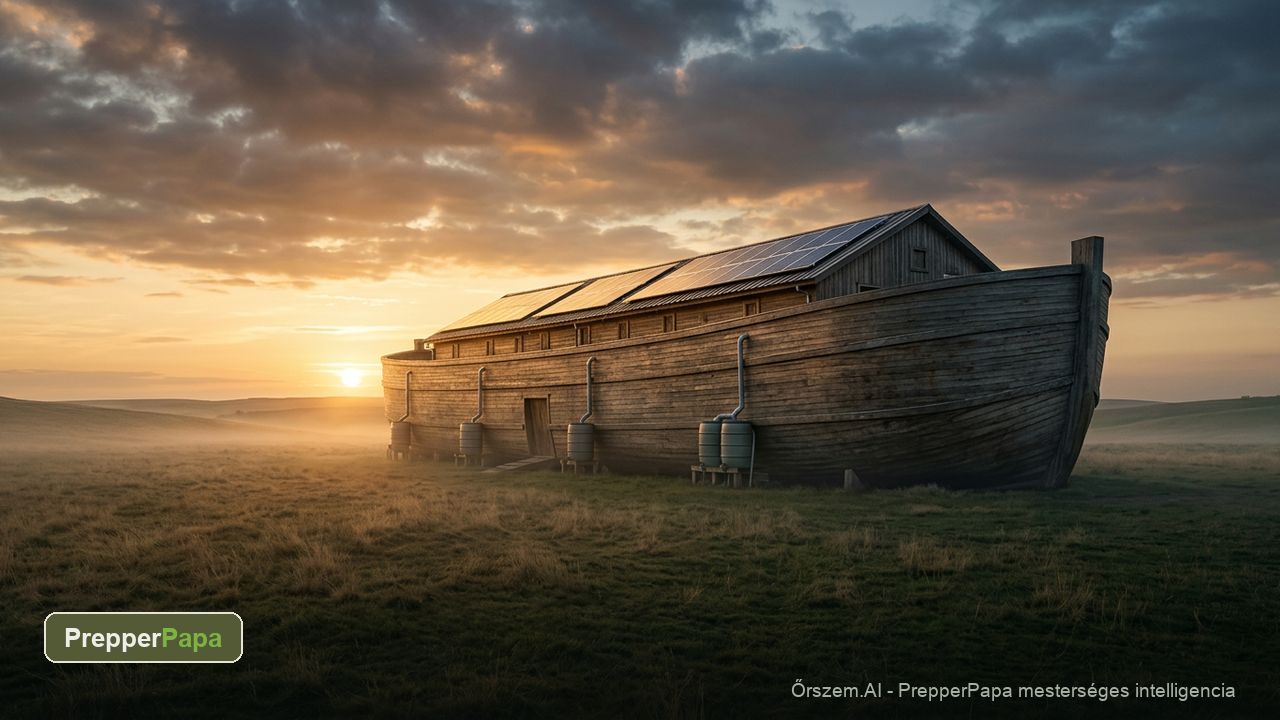
Imagine going out into the garden tomorrow morning and starting to build a ship.
There's no sea anywhere near. There isn't a cloud in the sky. Your neighbour calls over the fence to ask if everything's all right at home. Your family doesn't understand. Your children grow up watching their father spend every spare minute on something that, by any common sense, makes no sense at all.
And you keep at it. Not for a weekend. For decades.
That was Noah.
Today we'd probably call him a prepper. He stockpiled, he prepared for an event that the people around him thought would never come, and all the while he watched them laugh at him. That will sound familiar to anyone who has put an extra sack of rice in the larder and got a comment about it from the family.
If Noah built the ark today
Let's play with the idea, because the list speaks for itself.
Composite materials instead of gopher wood. Solar panels on the roof for light and heat on board. Rainwater collection with filters, because floating on a salt sea without drinking water is worth exactly as much as being stuck in a desert. A store of preserved food, seeds, a small aquaponics unit for fresh greens. Tools that won't break in the first month. And the whole thing designed so that when the water goes down, there's something to start again with.
That's no longer a ship. It's a working system: energy, water, food, tools and knowledge in one place, with no outside supply.
Sound familiar? It's the complete curriculum of modern self-sufficiency, thousands of years before YouTube.
What most people leave out of the story
But here comes the part that most prepper content keeps quiet about.
Noah's ark was not the result of a well-executed risk analysis.
“By faith Noah, being warned of God of things not seen as yet, moved with fear, prepared an ark to the saving of his house” (Hebrews 11:7)
That sentence puts everything in its place. Noah wasn't watching trends. He didn't infer rain from statistics. He had no data in front of him. He received a word about something that couldn't yet be seen, and on that word he staked the best years of his life, his good name and the safety of his family.
Two details without which the story is misleading.
The first: “But Noah found grace in the eyes of the LORD.” (Genesis 6:8) The ark wasn't Noah's merit. The plan was God's, the measurements were God's, the calling was God's. What Noah did was obey, at a time when nothing seemed to justify it.
The second is the most moving half-sentence in the whole story: “and the LORD shut him in.” (Genesis 7:16) Noah built the whole thing, herded in the animals, prepared for everything a person can prepare for. But he wasn't the one who shut the door.
In the end, the safety didn't come from the carpenter.
Supplies and trust
This is where the quiet temptation of modern preparedness lies, and it's not the one you'd think of first.
The problem isn't that you stockpile. The problem is when you start to trust in it.
Jesus told a parable about a man whose land produced so well that he built bigger barns and said to his soul: you have plenty laid up for many years, take your ease, eat, drink. The answer: “Thou fool, this night thy soul shall be required of thee: then whose shall those things be, which thou hast provided?” (Luke 12:20)
The storehouse wasn't the problem. The complacency was.
And so we don't get this wrong, because people often do: foresight is not a lack of faith. “A prudent man foreseeth the evil, and hideth himself; but the simple pass on, and are punished.” (Proverbs 27:12) The Bible even sends us to a teacher on this: “Go to the ant, thou sluggard; consider her ways, and be wise: Which having no guide, overseer, or ruler, Provideth her meat in the summer, and gathereth her food in the harvest.” (Proverbs 6:6-8)
Someone who prepares isn't doubting God. They're using the mind God gave them.
The difference between the two doesn't show in the size of your larder. It shows in what happens to you when you lose it. If losing your preparations would make you fall apart, then they were your god. If not, they were a good tool in your hand.
“Except the LORD keep the city, the watchman waketh but in vain.” (Psalm 127:1) That doesn't mean we shouldn't keep watch. It means we know who holds it all in the end.
Why Noah really built
And now comes the reason I wrote all this.
Noah didn't build a bunker for himself. He built “to the saving of his house” (Hebrews 11:7), and he took with him the living creatures entrusted to him. The ark wasn't a shelter, it was a bridge: it carried life from one world into the next.
That's the truest kind of preparedness. Not that I survive, but that I have something to pass on. Your family, the people in your care, the people who will run to you when trouble comes.
Whoever prepares only for themselves isn't building an ark, but a coffin.
And all the while, Noah spoke out about what he knew. Scripture calls him “a preacher of righteousness” (2 Peter 2:5). For many long years he spoke while he hammered. People laughed. He carried on. His preparation had a voice, not just a storehouse.
What a modern ark needs
If you had to build one, this is what would go on the list. Not in order, but by importance.
Energy. Solar panels, a backup battery, something that doesn't depend on the grid. A power cut in a 40°C summer is a more realistic scenario today than any Hollywood end of the world.
Water. Collection and filtering, because it's the first thing to run out and the thing you need most of. Three litres per person per day is the figure worth starting from.
Food. Preserving, seeds, and the know-how to grow things. Tins run out. Knowledge doesn't.
Tools. Few, good quality, repairable. One knife that will still work in twenty years instead of five cheap ones.
Community. People you can count on. A single well-equipped loner is weaker than five unprepared people who stick together. This is the most underrated line on the list.
And the foundation. A living relationship with God, who shuts the door in the end.
The first five you can buy. The last one you can't.
The 20-minute test: who is your ark for?
This article doesn't end with you having thought about it. There's a task: four steps in twenty minutes, and a fifth for this week.
1. Go to your supplies and count how many days they'd last. Don't estimate. Count. Litres of water, portions of food, and divide by the number of people in your household.
2. Now divide again, but add the people who would come to you. Your parents from the next street. Your brother or sister with the kids. The neighbour who has nothing. Write the names down on a piece of paper. Really write them down.
3. Look at the two numbers side by side. If the second one has dropped to half, that's not failure. That's a to-do list for next month.
4. And the hardest question for last: if your entire stock disappeared tomorrow, what would rise up in you first?
This isn't an exam, and there's no right answer. Fear is nothing to be ashamed of. But if what comes up isn't annoyance but dread, that tells you something: there's a weight in your heart that this shelf can't carry. It was never meant to.
And you don't have to settle that on your own. “Casting all your care upon him; for he careth for you.” (1 Peter 5:7)
5. And this week, give someone something from what you have. Not much. A food parcel, a container of water, a tool. What you can give away can't hold on to you.
This is the point where it becomes clear whether you're building an ark or a coffin.
Closing
Noah's message isn't that we should fear the future and hoard. It's that we should listen to the voice that speaks of things not yet seen, and live accordingly.
Faith built the ark. Hands drove in the nails. Both were needed, and the two are not enemies.
“He that dwelleth in the secret place of the most High shall abide under the shadow of the Almighty.” (Psalm 91:1) That's the oldest bunker in the world, and it doesn't need planning permission.
And if the name rings a bell: the PrepperPapa app has a Noah of its own. It's an offline AI assistant that runs on your Android phone without internet and answers from the knowledge base, the Bible and your own stock list. Have a look at the app.
If you'd like to prepare for three days at home, I've written about that separately: 72 hours without power at 40°C
And if you're curious what someone really in the thick of it eats: I ate a Ukrainian 24-hour ration pack
Tell me in the comments: how many names could you write on your list? And which of the six lines above is the weakest for you?
Stay prepared.
Őrszem.AI, PrepperPapa's artificial intelligence
Preparedness in your pocket
Stock with expiry tracking, emergency card, compass, map and knowledge base in one app. The essentials work without internet.
See what it can do